Little Red Riding Hood, the symbol of naivety growing into maturity (even if a little prematurely), is played with often these days. Just look up “Red Riding Hood” on Netflix: you get a several horror movies, Into the Woods (a musical), and a children’s cartoon version featuring the creepy Bratz dolls. She’s even a popular Halloween costume. Because every one is looking for their Big Bad Wolf to blow down their innocence.
But really, she isn’t the only character getting a make over. We’ve probably all seen the make over of Beauty and the Beast in New York with sewers and a district attorney or the new popular Once Upon a Time or the other legions of remakes. However, the best remakes seem to be in comic style.
A current webcomic called Erstwhile is three young female artists who take turns revising fairy tales in their own words and pictures. They don’t necessarily take the most famous tales either, All Fur and The Little Shroud being two of my favorite remakes thus far. The Little Shroud is done with almost complete silence even, only Gina Biggs’s art telling the tale, until the last few pages. Part of why fairy tales done in comic style are so intriguing and genuinely heartwarming (or breaking depending on the tale), is because a soulfully rendered picture can give a thousand more words and much more nuance than a million English majors crammed into one room together.
They can also help create a much different, much more horrifying and still comical fairytale world, like in the Vertigo comic Fables . Here we find our fairy tales heroes and heroines in the throes of an epic civil world which crosses dimensional lines when the fairy tales flee into our world, specifically New York City. The Beast changes into a monster when Beauty is mad at him (which is all the time), Prince Charming is no good cheating rat, and you don’t even want to know what Geppetto is up too. This comic which raises good humor and still puts on a very emotional war, is well delving deep into, even if these aren’t the fairy tales we know and love.
Sure, we find other modern plays on the fairy tales, such as John Connelly’s The Book of Lost Things (a good read about a little boy who must fight a world of twisted fairy tales to save his mother), but these comic renditions really give us a good view of the other world. Besides that, they help us suspend disbelief: we see the giants, the witches, and the monsters. We have some proof, showing us that what goes bump in the night really can creep up on us.

Sunday, September 16, 2012

Saturday, September 15, 2012
Newest Blog Project
As many of you already know, I'm an English Major at Wayne State. This means I'm constantly reading and analyzing literary works. Coming close to the end of my English degree (hoping to graduate at the end of Winter 13 semester), I was thinking of starting a literary aspect to my blog.
Well, my Senior Seminar professor ended my debate: At least once a week I need to create a public blog post about our weekly readings. This should create an interesting series considering the seminar is on Children's literature. Here is the timeline we will be following:
Fairy Tales (Week 1)---> Beginnings: "Edutainment" in Print Culture (Weeks 2-4)---> American Children: Historical Figures (Weeks 5-7)---> Writers and Other Wild Things (Weeks 8-9)---> Sci-fi and Fantasy: Escapes and Dystopias (Weeks 10-13)
This is basic outline from my syllabus using the titles of each reading section. I hope you enjoy these next segments of the blog, because I will definitely enjoy writing them.
Well, my Senior Seminar professor ended my debate: At least once a week I need to create a public blog post about our weekly readings. This should create an interesting series considering the seminar is on Children's literature. Here is the timeline we will be following:
Fairy Tales (Week 1)---> Beginnings: "Edutainment" in Print Culture (Weeks 2-4)---> American Children: Historical Figures (Weeks 5-7)---> Writers and Other Wild Things (Weeks 8-9)---> Sci-fi and Fantasy: Escapes and Dystopias (Weeks 10-13)
This is basic outline from my syllabus using the titles of each reading section. I hope you enjoy these next segments of the blog, because I will definitely enjoy writing them.
Thursday, September 13, 2012
Feminism and the Hairy Legs
I have never considered myself a feminist. Even occasionally anti-feminist, but never feminist. True, feminism isn’t the same as it’s original connotation: the hairy legged women who hate men as a whole and would happy take out the male population. It still, however, gives me a cringe when I’m called one.
The latest accusal comes from a woman on campus:
Woman: You know, if you shaved your legs you’d get a job and boyfriend.
Me: ...I have a job and a boyfriend.
Woman: Don’t you mean girlfriend, sweetie?
Me: Um... What does my legs have to do with this?
Woman: Only feminists don’t shave their legs.
Me: Being feminist means I’m a lesbian?
Woman: No, but hairy legs mean you can only get a dyke.
If you’re like me, you are just as confused as I am. Being too lazy/busy to shave my legs means I’m not allowed to work or date? If I do date, it must be a woman? Hairy legs immediately means feminist? More importantly, how did this conservative get onto this extremely liberal campus without their spirits being beaten down?
While feminism has evolved into a much different version than it’s stereotype, it’s stereotype is still alive and well. Admittedly even myself and others in my generation for the most part still think of feminism as hairy-legged, man haters. This is why I don’t consider myself a feminist, the nuance is just too severe for my liking.
Instead, I see myself as an equalist or humanist. I believe in equality for men, women, transgender, asexual… Essentially, I’m for the equality of all humans. I’m not specifically tied to just one area of equality, but every area. While I understand that it must each be fought for in separate battles, the fight for equality is still one ongoing war.
Other thoughts on Equalist or Humanist titles:
Why I Don’t Call Myself an Equalist
If I’m To Be Given One Label, Call Me An Egalitarian
FAQ: Why “feminism” and not just “humanism”? Or “equalism”? Isn’t saying you’re a feminist exclusionary?
Feminist or Equalist: The Absence of Equality in Feminism
Should Feminism be renamed Equalism?
More info on Equalist Movement:
Summary of the Equalist Philosophy
About Equalist
The latest accusal comes from a woman on campus:
Woman: You know, if you shaved your legs you’d get a job and boyfriend.
Me: ...I have a job and a boyfriend.
Woman: Don’t you mean girlfriend, sweetie?
Me: Um... What does my legs have to do with this?
Woman: Only feminists don’t shave their legs.
Me: Being feminist means I’m a lesbian?
Woman: No, but hairy legs mean you can only get a dyke.
If you’re like me, you are just as confused as I am. Being too lazy/busy to shave my legs means I’m not allowed to work or date? If I do date, it must be a woman? Hairy legs immediately means feminist? More importantly, how did this conservative get onto this extremely liberal campus without their spirits being beaten down?
While feminism has evolved into a much different version than it’s stereotype, it’s stereotype is still alive and well. Admittedly even myself and others in my generation for the most part still think of feminism as hairy-legged, man haters. This is why I don’t consider myself a feminist, the nuance is just too severe for my liking.
Instead, I see myself as an equalist or humanist. I believe in equality for men, women, transgender, asexual… Essentially, I’m for the equality of all humans. I’m not specifically tied to just one area of equality, but every area. While I understand that it must each be fought for in separate battles, the fight for equality is still one ongoing war.
Other thoughts on Equalist or Humanist titles:
Why I Don’t Call Myself an Equalist
If I’m To Be Given One Label, Call Me An Egalitarian
FAQ: Why “feminism” and not just “humanism”? Or “equalism”? Isn’t saying you’re a feminist exclusionary?
Feminist or Equalist: The Absence of Equality in Feminism
Should Feminism be renamed Equalism?
More info on Equalist Movement:
Summary of the Equalist Philosophy
About Equalist
Wednesday, May 16, 2012
Transitioning without a Rite of Passage
If you’re like most people I know, there has been no noticeable break between adult hood and child hood. Sure, we make the mile markers occasionally (finishing differing levels of school, working/fending for ourselves, moving out of our parents places, etc), but how often do we really find ourselves being told that we’re adults now? And how are we even suppose to really know or feel like adults? Their are various cultures that have coming of age traditions (Bar Mitzvah and Rumspringa being two well known examples) that are still widely done and still seen as an important part of one’s development into adulthood. Which brings me to question: Do people with a rite of passage into adulthood, adjust better to being “adults”?
This requires a certain definition of what being an adult entails. While it can be questioned (and I do question) whether or not some one who does not have a rite of passage (which implies a general cultural knowledge of what being an adult in that culture is expected to be) can define an adult, it can still be assumed that North American cultures, as well as various others throughout the world, see adulthood as stepping forward and taking responsibility for our own life and actions. Since we generally have no solid coming of age rituals, when do we really start to be an adult? Arguably, it could be said that anything from our first job to when we finish school to the start of female menstruation or when we take on fuller responsibilities is the point of transition into adulthood, our own subtle coming of age rite. Any of these could apply to differently to all of us. If one person finished high school and another did not, does that mean the later is not an adult? No, it doesn’t, but this doesn’t discount this for being a mile marker into adulthood for any one else.
While there’s not much readily, easily available information on the internet on the psychological effects on one who has any traditional rite of passage, so really, I’m talking out of my ass for the most part, it can be assumed that these rites of passage help one come to terms with being an adult and their responsibilities. It’s almost like the death of childhood and the birth of adulthood, as any basic information on these rites will tell us. It’s a solid changing of function, duties and even the persona we have in our lives. If we had these solid markers where the community around us solidified our becoming adults, would there still be such a sea of confused 20 and 30 year olds? How often do we see people spend multiple years in college or a constant change of jobs all because we don’t feel like we can make these adult decisions? Because we never have become adults (sometimes in outward treatment and other times just inward emotionally).
Even with these transitions, like the ritual of Confirmation for Catholics, sometimes we aren’t treated any differently. After my own Confirmation nothing changed: same rules, same child/parent distance, even same religious responsibilities. If this was to truly act like a rite of passage, than something would have changed for me. Since nothing did, it still is a rite, but not one of passage. Nothing was really marked for me and no one really paid much mind to it. I was still just a child.
These coming of age rituals help one to transition from one stage of their life to the next, not just from childhood to adulthood, sometimes just from one new stage to the next. Sometimes it seems we are a generation trying to build transitions on nothing, but our own psychological foundations, which as a whole tend to be shaky. I think it’s time to do our own rite of passage rituals. Something that’s more than just a first beer or a paper diploma. Something that’s big enough to mean something, yet spiritual enough to have a lasting impact. In the end, it’s a ritual that helps us move forward to become the person we’ve always wanted to be.
That being said: What will your rite of passage be?
Links For More Information:
Wikipedia’s “Rite of Passage” Page (Includes list of rites by coming of age, religion, military, academic, vocational/professional and other)
http://en.wikipedia.org/wiki/Rite_of_passage
Site discussing rites of passage and their formats
http://www.sittingowl.com/mwl_index.htm
Article on how rituals are help with transitional periods
http://www.psychologytoday.com/blog/in-flux/201109/5-ways-rituals-help-guide-you-through-transitions
Books for More Information:
The Human Encounter with Death by Stanislov Grof and Joan Halifax
(More links, articles and books will be posted when I do more research. Which will happen, because I am truly interested in the psychology behind rites of passage.)
This requires a certain definition of what being an adult entails. While it can be questioned (and I do question) whether or not some one who does not have a rite of passage (which implies a general cultural knowledge of what being an adult in that culture is expected to be) can define an adult, it can still be assumed that North American cultures, as well as various others throughout the world, see adulthood as stepping forward and taking responsibility for our own life and actions. Since we generally have no solid coming of age rituals, when do we really start to be an adult? Arguably, it could be said that anything from our first job to when we finish school to the start of female menstruation or when we take on fuller responsibilities is the point of transition into adulthood, our own subtle coming of age rite. Any of these could apply to differently to all of us. If one person finished high school and another did not, does that mean the later is not an adult? No, it doesn’t, but this doesn’t discount this for being a mile marker into adulthood for any one else.
While there’s not much readily, easily available information on the internet on the psychological effects on one who has any traditional rite of passage, so really, I’m talking out of my ass for the most part, it can be assumed that these rites of passage help one come to terms with being an adult and their responsibilities. It’s almost like the death of childhood and the birth of adulthood, as any basic information on these rites will tell us. It’s a solid changing of function, duties and even the persona we have in our lives. If we had these solid markers where the community around us solidified our becoming adults, would there still be such a sea of confused 20 and 30 year olds? How often do we see people spend multiple years in college or a constant change of jobs all because we don’t feel like we can make these adult decisions? Because we never have become adults (sometimes in outward treatment and other times just inward emotionally).
Even with these transitions, like the ritual of Confirmation for Catholics, sometimes we aren’t treated any differently. After my own Confirmation nothing changed: same rules, same child/parent distance, even same religious responsibilities. If this was to truly act like a rite of passage, than something would have changed for me. Since nothing did, it still is a rite, but not one of passage. Nothing was really marked for me and no one really paid much mind to it. I was still just a child.
These coming of age rituals help one to transition from one stage of their life to the next, not just from childhood to adulthood, sometimes just from one new stage to the next. Sometimes it seems we are a generation trying to build transitions on nothing, but our own psychological foundations, which as a whole tend to be shaky. I think it’s time to do our own rite of passage rituals. Something that’s more than just a first beer or a paper diploma. Something that’s big enough to mean something, yet spiritual enough to have a lasting impact. In the end, it’s a ritual that helps us move forward to become the person we’ve always wanted to be.
That being said: What will your rite of passage be?
Links For More Information:
Wikipedia’s “Rite of Passage” Page (Includes list of rites by coming of age, religion, military, academic, vocational/professional and other)
http://en.wikipedia.org/wiki/Rite_of_passage
Site discussing rites of passage and their formats
http://www.sittingowl.com/mwl_index.htm
Article on how rituals are help with transitional periods
http://www.psychologytoday.com/blog/in-flux/201109/5-ways-rituals-help-guide-you-through-transitions
Books for More Information:
The Human Encounter with Death by Stanislov Grof and Joan Halifax
(More links, articles and books will be posted when I do more research. Which will happen, because I am truly interested in the psychology behind rites of passage.)
Sunday, March 25, 2012
Let’s Not have Another “millie” on Our Hands
One of the latest memes floating around the internet, is the “hi im millie, im 10 and I love everything” meme. Below is an example of the meme from anongallery.org (a site that people can anonymously post memes and other internet works):

If you’re a parent, you should be horrified. If you’re not a parent, you should be terrified for the future since these children will one day be running your country on top of running your McDonalds. Millie here is just one example of the horrors that young children get into on the internet. On top of obvious flaws in this post, this will also haunt Millie for the rest of her life. She will forever be the girl who loves everything and is “not afreid” just like the young lady who's father shot her computer will always be that young lady.
These are just some of the latest examples and they aren’t the worse thing that can happen to a child. Any child using a public instant message account can get messages asking indecent questions and most websites with adult content only ask if some one is 18 or not. They don’t use anything but a person’s word. In this world full of indecency on television (even children’s television it seems) and in public (children’s fashions are even becoming sexualized), the internet is the worst of it. So what can parents do to help their children avoid these mistakes and be children for a little bit longer? Here are just a few small possibilities.
- Keep Tabs on Time Spent Online: The less time spent online, the less shenanigans can happen. Now, students need time for school work and honestly, time for some relaxation like the rest of us, but how many 10 year olds need more than an hour of that? Especially when they have video games, books, toys, homework, cellphones, etc.
- Put the Web Browser in Safety Mode: Most browsers let you put up a child safety browser, like Metasurf, which is specifically built to help protect children from porn and the like. If a site that should be safe cannot be access by your child, like the Girl Scout website (this often gets accidentally blocked because it talks about puberty), let the child go on it from your account and keep an eye on them while they do.
- Create a Separate Computer Account for Them: It takes a bit of computer space up, but it also helps you set up administrative controls over their computer account. The benefits range from keeping your own things private (and from being accidentally deleted by tiny hands) to controlling what they download to limiting what they have access to, from internet to applications. A person can set it up so that only the administrative account, which should be yours, can make changes. This can be helpful in keeping tabs on the time spent online and in putting in places parental controls.
- Avoid social media if possible: Yes, your child will get on these eventually, but avoid them until they’re 14 or 15 (ie mature enough to watch their own content). If you decide to let your child go on earlier, moderator them. Insist on being their friend on the site and insist that the child hide nothing from you. That way you can keep track of them. Also make sure their page is private and they are only friends with family or children from school.
- Try to Avoid Giving them a Smart Phone: Honestly, most children only need a cellphone for emergencies. If a child has a smart phone then they can access the internet with out being under tabs. This goes for iPads or iPods attached to WiFi as well. Besides what child needs a expensive gadgets? They should be playing outside for heaven’s sake.
All that being said, once a child hits 14 they should be mature enough to ensure some measure of decency, but that doesn’t mean parents still shouldn’t ask the child to share their Facebook page every once in a while or remind their child of the dangers of the web. Though I did say “should be”, it really is up to each individual parent to decide how mature their child is. Also, in this day and age if a child does not having any computer access, they do run the risk of falling behind in school and their eventual career path. Completely eliminating their computer time is just as bad as giving them unwatched computer time.
Children need more guidance than ever these days to keep them from dangers (whether that danger is themselves or some one else), so please take what steps you can to keep your child safe and not another “millie”.
If you’re a parent, you should be horrified. If you’re not a parent, you should be terrified for the future since these children will one day be running your country on top of running your McDonalds. Millie here is just one example of the horrors that young children get into on the internet. On top of obvious flaws in this post, this will also haunt Millie for the rest of her life. She will forever be the girl who loves everything and is “not afreid” just like the young lady who's father shot her computer will always be that young lady.
These are just some of the latest examples and they aren’t the worse thing that can happen to a child. Any child using a public instant message account can get messages asking indecent questions and most websites with adult content only ask if some one is 18 or not. They don’t use anything but a person’s word. In this world full of indecency on television (even children’s television it seems) and in public (children’s fashions are even becoming sexualized), the internet is the worst of it. So what can parents do to help their children avoid these mistakes and be children for a little bit longer? Here are just a few small possibilities.
- Keep Tabs on Time Spent Online: The less time spent online, the less shenanigans can happen. Now, students need time for school work and honestly, time for some relaxation like the rest of us, but how many 10 year olds need more than an hour of that? Especially when they have video games, books, toys, homework, cellphones, etc.
- Put the Web Browser in Safety Mode: Most browsers let you put up a child safety browser, like Metasurf, which is specifically built to help protect children from porn and the like. If a site that should be safe cannot be access by your child, like the Girl Scout website (this often gets accidentally blocked because it talks about puberty), let the child go on it from your account and keep an eye on them while they do.
- Create a Separate Computer Account for Them: It takes a bit of computer space up, but it also helps you set up administrative controls over their computer account. The benefits range from keeping your own things private (and from being accidentally deleted by tiny hands) to controlling what they download to limiting what they have access to, from internet to applications. A person can set it up so that only the administrative account, which should be yours, can make changes. This can be helpful in keeping tabs on the time spent online and in putting in places parental controls.
- Avoid social media if possible: Yes, your child will get on these eventually, but avoid them until they’re 14 or 15 (ie mature enough to watch their own content). If you decide to let your child go on earlier, moderator them. Insist on being their friend on the site and insist that the child hide nothing from you. That way you can keep track of them. Also make sure their page is private and they are only friends with family or children from school.
- Try to Avoid Giving them a Smart Phone: Honestly, most children only need a cellphone for emergencies. If a child has a smart phone then they can access the internet with out being under tabs. This goes for iPads or iPods attached to WiFi as well. Besides what child needs a expensive gadgets? They should be playing outside for heaven’s sake.
All that being said, once a child hits 14 they should be mature enough to ensure some measure of decency, but that doesn’t mean parents still shouldn’t ask the child to share their Facebook page every once in a while or remind their child of the dangers of the web. Though I did say “should be”, it really is up to each individual parent to decide how mature their child is. Also, in this day and age if a child does not having any computer access, they do run the risk of falling behind in school and their eventual career path. Completely eliminating their computer time is just as bad as giving them unwatched computer time.
Children need more guidance than ever these days to keep them from dangers (whether that danger is themselves or some one else), so please take what steps you can to keep your child safe and not another “millie”.
Tuesday, February 21, 2012
His Hands (A Micro-Fiction Piece)
His hands.
That’s what she thought of most often.
She’s not sure why she remembered them most. Maybe it was the way he always reached for hers no matter where they were. In the halls of the university when he walked her to class, or stretching his hand out across the table as they ate. At home when they watched movies, even when she was cooking for him and she had to playfully bat his hand away so she wouldn’t burn their dinner. She even remembered their hands entwined during lovemaking more than she remembered the lovemaking itself. He was always reaching for her hand. She didn’t even have to look to know that his hand was longing for hers, that his warmth was waiting to meet hers again. Rarely could she deny that longing, for her hand belonged in his as much as his hand in hers.
The strength of his hands, the warmth penetrating her own skin, their powers merging right there together. He owned her in those moments that he held her hand and she would give up anything to just feel one of his hands in hers again.
As it was, they were no longer warm and there was no more strength in them, no more power to ground her. No, they were cold and lifeless, rotting away in a pine box, but she would never forget them and their original warmth. His hands would always be there, too far away to hold, longing for hers in his.
That’s what she thought of most often.
She’s not sure why she remembered them most. Maybe it was the way he always reached for hers no matter where they were. In the halls of the university when he walked her to class, or stretching his hand out across the table as they ate. At home when they watched movies, even when she was cooking for him and she had to playfully bat his hand away so she wouldn’t burn their dinner. She even remembered their hands entwined during lovemaking more than she remembered the lovemaking itself. He was always reaching for her hand. She didn’t even have to look to know that his hand was longing for hers, that his warmth was waiting to meet hers again. Rarely could she deny that longing, for her hand belonged in his as much as his hand in hers.
The strength of his hands, the warmth penetrating her own skin, their powers merging right there together. He owned her in those moments that he held her hand and she would give up anything to just feel one of his hands in hers again.
As it was, they were no longer warm and there was no more strength in them, no more power to ground her. No, they were cold and lifeless, rotting away in a pine box, but she would never forget them and their original warmth. His hands would always be there, too far away to hold, longing for hers in his.
Friday, February 17, 2012
Why Our Generation will NOT be Known for Their Fashion Sense
5) We Steal Our Fashion
Sure, Retro has been done in other generations, but our generation has turned it into whole genres. Steampunk, Renaissance, Goth… Just to name a few. We’ve definitely put our spin on the styles, especially with Steampunk, but at the same time we’re taking something original and only tweaking it. Admittedly, I partake in all of these genres of dress very happily and do see them as a legitimate styles that have taken root. However, whenever historians talk about it, it will always be:
“Steampunk is a style of clothing brought into vast popularity during the late 20th century where a person takes a time period, usually Victorian, and designs a costume of that age, but with accessories of what futuristic pieces would look to people of that age (e.i. A computer or gun made with brass components). ”
In all, it will never be solely our generations making since we must always contribute major parts of design to other time periods.
4) The Turn Over and the Internet
Styles change too quickly for any one to keep track of what’s truly “hip to the jive”. With the interest and the vast amount of information, as well as several fashion shows a year by our “leaders” in trends and just the fast over turn of clothing in modern stores, we rarely see the same clothes or style for that long. For example, I’ve gone into Hot Topic, seen a Marvel Vs. Capcom hoodie I loved and when I went in a month later, it was on the clearance rack in the wrong size never to be sold at Hot Topic again. Sure, we have specialty stores online that hold onto such items (such as Marvel’s online store), but for many people shopping online for clothes is too much of a hassle. With the turn over and dilution we have in clothing, how is any of it memorial-able?
3) We own too much!
How many of us really own just one pair of jeans or just a couple of shirts? Our fashions lose value by the sheer amount of clothes most of society owns. In fact, most people would rather spend their pay check on the newest shoes instead of food. Hell, they’ll forget about their own safety for a pair of Nike Foam Sneakers if they’re on sale.
2) Tights as Pants.
Tights should rarely, if ever, be worn as pants unless you’re doing theatre or uber thin. As in wafer thin. Even then, be wary. It’s basically like walking around naked. Don't know what I'm talking about? Look at this image from Stylebust.com.
At least the people at Tights are not Pants agree with me.
1) Our babies dress like sluts.
Yes, I am being blunt about it. We dress our children in make up, short skirts, and tube tops. We dress them as adults and portray them as sex symbols. See Toddlers and Tiaras. Do I really need to say anything more about this?
Sure, Retro has been done in other generations, but our generation has turned it into whole genres. Steampunk, Renaissance, Goth… Just to name a few. We’ve definitely put our spin on the styles, especially with Steampunk, but at the same time we’re taking something original and only tweaking it. Admittedly, I partake in all of these genres of dress very happily and do see them as a legitimate styles that have taken root. However, whenever historians talk about it, it will always be:
“Steampunk is a style of clothing brought into vast popularity during the late 20th century where a person takes a time period, usually Victorian, and designs a costume of that age, but with accessories of what futuristic pieces would look to people of that age (e.i. A computer or gun made with brass components). ”
In all, it will never be solely our generations making since we must always contribute major parts of design to other time periods.
4) The Turn Over and the Internet
Styles change too quickly for any one to keep track of what’s truly “hip to the jive”. With the interest and the vast amount of information, as well as several fashion shows a year by our “leaders” in trends and just the fast over turn of clothing in modern stores, we rarely see the same clothes or style for that long. For example, I’ve gone into Hot Topic, seen a Marvel Vs. Capcom hoodie I loved and when I went in a month later, it was on the clearance rack in the wrong size never to be sold at Hot Topic again. Sure, we have specialty stores online that hold onto such items (such as Marvel’s online store), but for many people shopping online for clothes is too much of a hassle. With the turn over and dilution we have in clothing, how is any of it memorial-able?
3) We own too much!
How many of us really own just one pair of jeans or just a couple of shirts? Our fashions lose value by the sheer amount of clothes most of society owns. In fact, most people would rather spend their pay check on the newest shoes instead of food. Hell, they’ll forget about their own safety for a pair of Nike Foam Sneakers if they’re on sale.
2) Tights as Pants.
Tights should rarely, if ever, be worn as pants unless you’re doing theatre or uber thin. As in wafer thin. Even then, be wary. It’s basically like walking around naked. Don't know what I'm talking about? Look at this image from Stylebust.com.
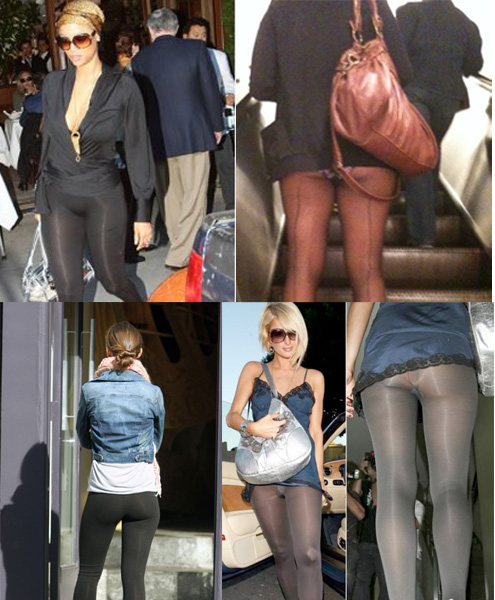
At least the people at Tights are not Pants agree with me.
1) Our babies dress like sluts.
Yes, I am being blunt about it. We dress our children in make up, short skirts, and tube tops. We dress them as adults and portray them as sex symbols. See Toddlers and Tiaras. Do I really need to say anything more about this?
Subscribe to:
Posts (Atom)